
Best Headphones for Glasses Wearers: Comfort-First Picks (2026)
Disclosure: As an Amazon Associate, we earn from qualifying purchases. This costs you nothing extra and does not change which products we pick. Read our disclosure.
Headphones can press the arms of your glasses against the sides of your head, so comfort over a long session matters more than the first few minutes. Reviewers point to soft, dense padding, a gentle clamp (how hard the headband squeezes your head) and moderate weight. If headphones press on your ears or your glasses, see our guide to headphones and earbuds that hurt your ears.
We compared five over-the-head headphones using TechGearLab’s measured wear times, which include glasses, and SoundGuys reviewers who wear glasses. We also list models that reviewers found uncomfortable, so you know what to check first.
How we researched this
We don’t test products ourselves. The comfort evidence comes from TechGearLab’s wireless headphone tests, SoundGuys’ ACCENTUM Plus review and OpenMeet review, plus the makers’ own spec pages. We found no independent clamping-force measurements for these models, and head and frame shapes differ. See the full method.
Quick answer
For most glasses wearers, the Bose QuietComfort Ultra Headphones (2nd Gen) are the safest pick.
TechGearLab wore them 10+ hours and says the earcups stay comfortable “even with glasses on.” On a budget, TechGearLab’s testers wore the TOZO HT3 comfortably for 7.5 hours, though it felt too large for some smaller heads. If ear cups are the problem, the Shokz OpenMeet has none: it is a bone conduction headset, so sound travels through your cheekbones and your ears stay open. Not sure it fits your head? Buy where returns are easy and wear them for a full day.
Jump to your situation
Best for glasses overall
Bose QuietComfort Ultra Headphones (2nd Gen)
TechGearLab wore it 10+ hours without issues, with a padded headband and earcups that stay comfortable with glasses on.
Price band: Over $250
Best budget
TOZO HT3
TechGearLab names it and the 1More SonoFlow Pro the most comfortable headphones under $100: worn comfortably for 7.5 hours, but too large for some smaller heads.
Price band: Under $50
Best for calls without ear pressure
Shokz OpenMeet
Bone conduction headset (sound through your cheekbones, ears left open) with a strong mic, per SoundGuys; it can slip when you look down.
Price band: $100–$150
How long reviewers could wear each pair
TechGearLab measures how long it can wear each pair of headphones and says the measure includes wearing glasses. These are its hours for popular models and our picks. The ACCENTUM Plus and Shokz OpenMeet are not in its table; our evidence for them is SoundGuys’ reviewers.
| Headphones | Hours worn comfortably | In this guide |
|---|---|---|
| Bose QuietComfort Ultra (2nd Gen) | 10 | Our pick |
| Sennheiser Momentum 4 | 10 | Our pick |
| 1More SonoFlow Pro | 8 | Not one of our picks; testers noticed their glasses more while wearing it |
| TOZO HT3 | 7.5 | Our pick |
| Sony WH-1000XM6 | 7 | Not one of our picks |
| Sony WH-1000XM5 | 6 | Not one of our picks |
| Beats Studio Pro | 3.5 | Check first: see list below |
| Sony WH-CH520 | 2 | Check first: see list below |
| JBL Tune 720BT | 2 | Check first: see list below |
| Beats Solo 4 | 1 | Check first: see list below |
Top picks compared
Weights are the makers’ figures, except the Amazon listings for the ACCENTUM Plus and the Momentum 4. Bose lists 0.583 lb for the headphones alone. The comfort-with-glasses column comes from TechGearLab for the Bose, Momentum 4 and TOZO, and from SoundGuys for the ACCENTUM Plus and Shokz.
| Product | Weight | Comfort with glasses | Price band | Best for | Link |
|---|---|---|---|---|---|
| Bose QuietComfort Ultra Headphones (2nd Gen) Safest pick | About 264 g (0.583 lb, Bose) | Testers wore it 10+ hours with glasses on, without complaints | Over $250 | Long days with glasses and noise canceling | Check price on Amazon (opens in a new tab) |
| Sennheiser Momentum 4 Wireless | About 293 g (Amazon listing) | Testers wore it 10+ hours with glasses on, without complaints | $150–$250 | Glasses wearers who want a long battery | Check price on Amazon (opens in a new tab) |
| Sennheiser ACCENTUM Plus | 227 g (Amazon listing) | A reviewer who wears glasses says the soft padding does not press on the arms | $150–$250 | A lighter mid-range pair for glasses | Check price on Amazon (opens in a new tab) |
| TOZO HT3 | 257 g (TOZO) | Testers wore it 7.5 hours; too large for some smaller heads | Under $50 | The lowest price with decent comfort | Check price on Amazon (opens in a new tab) |
| Shokz OpenMeet | 78 g (Shokz) | A reviewer who wears glasses found it comfortable for hours | $100–$150 | Work calls and long wear without ear pressure | Check price on Amazon (opens in a new tab) |
Bose QuietComfort Ultra Headphones (2nd Gen): best for glasses overall
Design: Over-ear, protein leather cushionsMic: Built-in microphonePrice band: Over $250
TechGearLab names this and the Sennheiser Momentum 4 its most comfortable headphones. Its testers wore each for 10+ hours straight without complaints. It says the padded headband spreads the weight evenly, the densely padded earcups stay comfortable and breathable even with glasses on, and the clamp (how hard the headband squeezes) is gentle. Bose’s specification page lists up to 30 hours of battery, Bluetooth 5.4, a built-in microphone and an included 3.5 mm cable, and its product page lists the headphones at 0.583 lb (about 264 g), without the case.
Pros
- 10+ hours of comfortable wear in TechGearLab’s test, with glasses included
- Gentle clamping force, per TechGearLab
- Up to 30 hours of battery, per Bose
- Includes a cable for wired listening, per Bose
Cons
- Premium price
- About 264 g, heavier than the ACCENTUM Plus’s 227 g (Amazon listing) though lighter than the Momentum 4’s 293 g
- TechGearLab found an earlier Bose model, the QuietComfort, was comfortable for 9 hours, an hour less for glasses wearers, so do not assume every Bose model is the same
Who should skip it
Skip it if you want to spend less, or if you prefer headphones that do not cover your ears at all.
What TechGearLab says
TechGearLab lists the Bose QuietComfort Ultra (2nd Gen) at 10 comfortable listening hours, the top of its table, and says its measure includes wearing glasses. We did not find a separate independent test of this model’s fit with glasses.
Sennheiser Momentum 4 Wireless: comfortable, long battery
Design: Over-earWeight: About 293 g (Amazon listing)Price band: $150–$250
TechGearLab gives the Momentum 4 the same 10-hour result as the Bose and the same praise: a padded headband, densely padded earcups and a gentle clamp. Sennheiser’s specification page lists up to 60 hours of battery with noise canceling on. Sennheiser’s US product page describes a lightweight design with a padded headband and deep cushioned earpads, which is the maker’s own claim, and neither of those pages lists a weight. The Amazon listing gives it as 293 g, heavier than the ACCENTUM Plus (227 g, Amazon listing) and the TOZO HT3 (257 g, TOZO), so the weight on the top of your head matters more here.
Pros
- 10+ hours of comfortable wear in TechGearLab’s test, with glasses included
- Gentle clamping force, per TechGearLab
- Up to 60 hours of battery with noise canceling on, per Sennheiser
Cons
- 293 g per the Amazon listing, more than the ACCENTUM Plus’s 227 g (Amazon listing) and the TOZO HT3’s 257 g (TOZO), so the headband carries more weight
Who should skip it
Skip it if you want a lighter pair, such as the ACCENTUM Plus at 227 g (Amazon listing), or a headset for calls; the Shokz below is built for that.
What TechGearLab says
TechGearLab puts the Momentum 4 at the top of its comfort table with the Bose, at 10 hours, and says the earcups are comfortable and breathable even with glasses on.
Sennheiser ACCENTUM Plus: soft pads for glasses arms
Design: Over-ear, plastic frameWeight: 227 g (Amazon listing)Price band: $150–$250
SoundGuys’ reviewer, who wears glasses, calls the very soft padding a nice touch for glasses wearers: it conforms to the arms of glasses rather than putting pressure on them. The headphones weigh 227 g and the plastic construction with no hinges means nothing to pinch or catch hair. The reviewer notes the ear cups are a bit narrow at 40 mm but wide enough for most ears.
Pros
- Light at 227 g, per the Amazon listing
- Very soft padding that conforms to glasses arms, per SoundGuys’ reviewer who wears glasses
- No hinges to pinch you or catch hair, per SoundGuys
Cons
- TechGearLab did not list it in its wear-time table, so we have no measured hours
- Plastic arms holding the ear cups, which SoundGuys says may not inspire confidence if you are rough on your gear
- Ear cups are slightly narrow (40 mm), though SoundGuys says wide enough for most ears
Who should skip it
Skip it if you want measured wear-time data; the Bose and Momentum 4 have it.
What SoundGuys says
The SoundGuys review (published 2024, updated March 2025) says glasses wearers should be all right with the ACCENTUM Plus, and that the soft padding is a nice touch for those who wear glasses. It is one reviewer’s experience, not a measured result.
TOZO HT3: best budget pick
Design: Over-ear, foldableWeight: 257 g (TOZO)Price band: Under $50
TechGearLab says the 1More SonoFlow Pro and the TOZO HT3 are the most comfortable headphones under $100, and it wore the HT3 for 7.5 hours. It adds that, compared with TOZO’s earlier HT2, the HT3 has a firmer but gentler clamp, and that it felt too large for some smaller heads. TOZO lists 257 g, Bluetooth 6.0 and up to 90 hours of battery with noise canceling off (55 hours at maximum noise canceling).
Pros
- 7.5 hours of comfortable wear in TechGearLab’s test, which names it one of the most comfortable pairs under $100
- Foldable, 257 g, per TOZO
- Up to 90 hours of battery with noise canceling off, per TOZO
Cons
- TechGearLab says it felt too large for some smaller heads
- Fewer comfortable hours than the Bose and Sennheiser picks (10)
- We found no independent mic test
Who should skip it
Skip it if you have a smaller head or need a headset for work calls.
What TechGearLab says
TechGearLab lists the HT3 at 7.5 comfortable hours and says the 1More SonoFlow Pro and HT3 impress with above-average comfort for the price, while testers noticed their glasses more on the SonoFlow.
Shokz OpenMeet: best for calls without ear pressure
Design: Bone conduction headsetWeight: 78 g (Shokz)Price band: $100–$150
SoundGuys’ reviewer, who wears glasses, found the OpenMeet UC comfortable for hours at a time and lists comfort with glasses as a strength. The reviewer says the cheekbone pads prevent pressure points. The mic is its strongest feature, with excellent quality in noisy places. The reviewer says it slides off your head when you look down, and it does not block outside noise. The Amazon listing we link is the Bluetooth OpenMeet without the wireless adapter. SoundGuys reviewed the OpenMeet UC, which Shokz sells as the same headset with a USB-A or USB-C wireless adapter. If you mainly want a headset with a mic for a laptop, see our laptop and PC headset guide.
Pros
- Comfortable with glasses and for hours at a time, per SoundGuys’ reviewer who wears glasses
- Excellent microphone quality in noisy environments, per SoundGuys
- 78 g and no cups over the ears, per Shokz
- Connects to two devices at once (multipoint), per SoundGuys
Cons
- Slips off the head when you look down, per SoundGuys
- Open ears: no noise canceling and you hear the room, so it can distract in shared offices
- SoundGuys says it suits few situations, which hurts its value for money
- The OpenMeet UC with the wireless adapter costs more
Who should skip it
Skip it if you want noise canceling, strong bass or headphones for travel.
What SoundGuys says
The SoundGuys review covers the OpenMeet UC (the adapter version); Shokz lists the Bluetooth OpenMeet and the UC as the same headset with and without the Loop120 adapter. SoundGuys describes its comfort and mic scores as editor-scored rather than measured.
Verdict
If you can spend over $250, the Bose QuietComfort Ultra Headphones (2nd Gen) have the strongest evidence: TechGearLab’s measured 10+ hours with glasses on. The TOZO HT3 is the budget choice if your head is not small, and the Shokz OpenMeet is the pick if ear pressure is the problem or you need a headset for calls.
Check these first if you wear glasses
Check first
Models reviewers flagged
- In TechGearLab’s table, testers were comfortable for only 2 hours in the Sony WH-CH520 and JBL Tune 720BT, 1 hour in the Beats Solo 4 and 3.5 hours in the Beats Studio Pro, against 10 hours for our top picks.
- RTINGS says the Fractal Scape, a gaming headset, clamps hard enough to put excess pressure on larger heads or glasses wearers over long gaming sessions.
- RTINGS lists the Audeze Maxwell 2 ANC, another gaming headset, as heavy with a high clamping force, and names the Sony INZONE H9 II as a lighter alternative at less than half the weight with a very light clamp.
Comfort depends on your head and your frames, so treat these as flags to check, not a ban.
How to make headphones comfortable with glasses
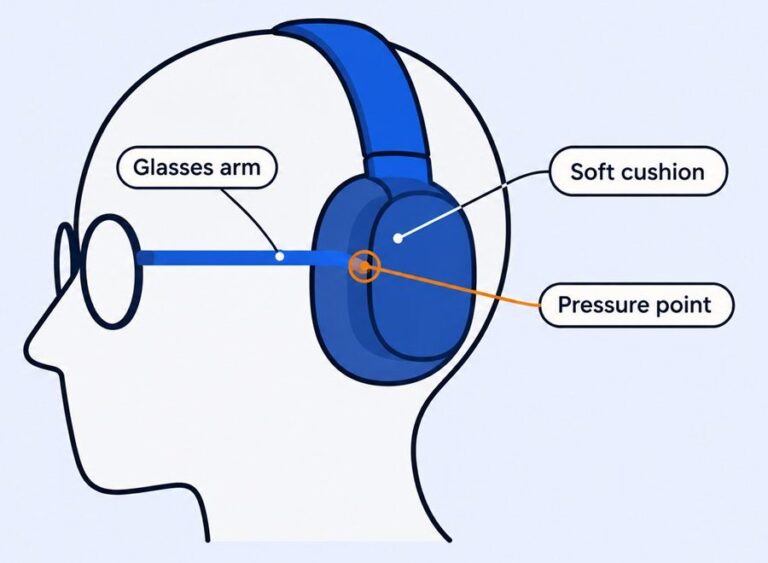
- Look at weight and padding first. TechGearLab says the Bose QuietComfort Ultra and Sennheiser Momentum 4 have padded headbands and densely padded earcups, and SoundGuys praises the ACCENTUM Plus’s soft padding.
- Look for a gentle clamp. TechGearLab credits the Bose and Momentum 4 with one, and RTINGS flags high clamping force as the problem on the Fractal Scape and Maxwell 2 ANC.
- If ear cups hurt whatever you try, a bone conduction headset such as the Shokz OpenMeet has no ear cups at all.
- Wear a new pair for a full work session with your glasses on, and keep the return window open until you have.
Need a headset with a mic for a laptop? See our headset and mic guide, or our wireless earbuds guide if you prefer earbuds.
If you have a smaller head, see our guide to headphones for small heads.
Frequently asked questions
What are the most comfortable headphones for glasses wearers?
TechGearLab wore the Bose QuietComfort Ultra (2nd Gen) and the Sennheiser Momentum 4 for 10+ hours each and says the earcups stay comfortable with glasses on. They were its most comfortable pairs.
Are over-ear headphones better for glasses?
TechGearLab’s most comfortable pairs, the Bose QuietComfort Ultra and Sennheiser Momentum 4, are both over-ear, with padded earcups and gentle clamping. Over-ear cups sit around the ear instead of on it, but comfort still depends on padding, weight and clamp.
Do bone conduction headphones work with glasses?
Some can. A bone conduction headset has no ear cups, so nothing presses on the arms of your glasses from the ear side. The one we found tested by a reviewer who wears glasses is the Shokz OpenMeet UC: SoundGuys found it comfortable for hours and lists “comfortable with glasses” as a strength, but says it slips off when you look down. We did not find glasses tests of other bone conduction models, so fit can differ.
What is the best budget headphone for glasses?
TechGearLab calls the 1More SonoFlow Pro and the TOZO HT3 the most comfortable headphones under $100. Testers wore the HT3 comfortably for 7.5 hours but it felt too large for some smaller heads, and testers noticed their glasses more on the SonoFlow.
Does clamping force matter with glasses?
Reviewers point to it. TechGearLab credits a gentle clamp on the Bose QuietComfort Ultra and Sennheiser Momentum 4, and RTINGS flags high clamping force on the Fractal Scape and Audeze Maxwell 2 ANC. We found no independent measurements for our picks, so check the return window.
How we research
For this guide we used TechGearLab’s measured wear times, SoundGuys and RTINGS reviews, and the makers’ own specifications. We do not test products ourselves, and we say where the evidence is thin. We look for reviewers who bought the product themselves and were not sponsored, and we use sponsored reviews as little as possible.
Written by