
Best Anti-Fatigue Mats for a Standing Desk: Thickness, Size and What Studies Say
Disclosure: As an Amazon Associate, we earn from qualifying purchases. This costs you nothing extra and does not change which products we pick. Read our disclosure.
An anti-fatigue mat is a cushioned pad you stand on at a standing desk. Two things decide whether one suits you: how big and how thick it is, and whether it will stay put and stay out of your way. Makers state those numbers in different ways, and one popular roundup prints a weight ten times too high, so this guide shows what each maker says before it says what we would pick.
We compare three mats you can buy on Amazon, in the under $50, $50–$100 and $100–$200 price bands as of November 22, 2026, and we also show the FlexiSpot MT1, which is sold on FlexiSpot’s own site, because TechRadar’s September 2025 roundup misprints its weight. The Canadian Centre for Occupational Health and Safety (CCOHS) says a mat may not solve the whole problem, and two studies found mats lowered discomfort compared with a hard floor without showing that any one mat is best. We found no lab test with measurements, so every figure here comes from a maker’s page, a seller’s Amazon listing or a named source, and the guide says which.
How we researched this
We don’t test products ourselves. Specs come from the makers’ own pages: Ergodriven’s Topo page, Vari’s Standing Mat Pro page and FlexiSpot’s MT1 page. Evidence on mats comes from CCOHS’s anti-fatigue mats fact sheet, a 2013 study in Human Factors and a 2022 study in Applied Bionics and Biomechanics. For findings from a published test we cite TechGearLab’s standing desk mat test (updated July 21, 2023). See the full method.
Quick answer
Measure the floor space first, then pick the mat that fits it.
If you want the one whose maker states the most (thickness in two places, weight, material and a 16-year warranty), that is the Ergodriven Topo, the only contoured mat here. If you want a flat mat, the Vari Standing Mat Pro states a 10-year warranty on a 32 by 20 inch surface. The ComfiLife is the lowest-priced and, in TechGearLab’s test, the softest of nine mats. Studies found mats lowered discomfort compared with a hard floor, but they did not show that one mat is better than another, so size, edges and fit matter as much as the brand.
Jump to your situation
Most stated by the maker
Ergodriven Topo Standing Desk Mat (Original)
The contoured Topo: thickness in two places, weight, material, returns and a 16-year warranty all on the maker’s page.
Price band: $100–$200
Flat mat, longest warranty
Vari Standing Mat Pro (32 x 20)
A 0.75 inch flat mat, 32 by 20 inches, with a 10-year warranty and a surface the maker says is slip-resistance certified.
Price band: $50–$100
Lowest price
ComfiLife Anti-Fatigue Floor Mat, 3/4 Inch (20 x 32)
A 0.75 inch flat memory-foam mat, 20 by 32 inches, in the lowest price band here; TechGearLab found it the softest of nine mats it tested.
Price band: Under $50
What studies and safety bodies say about mats
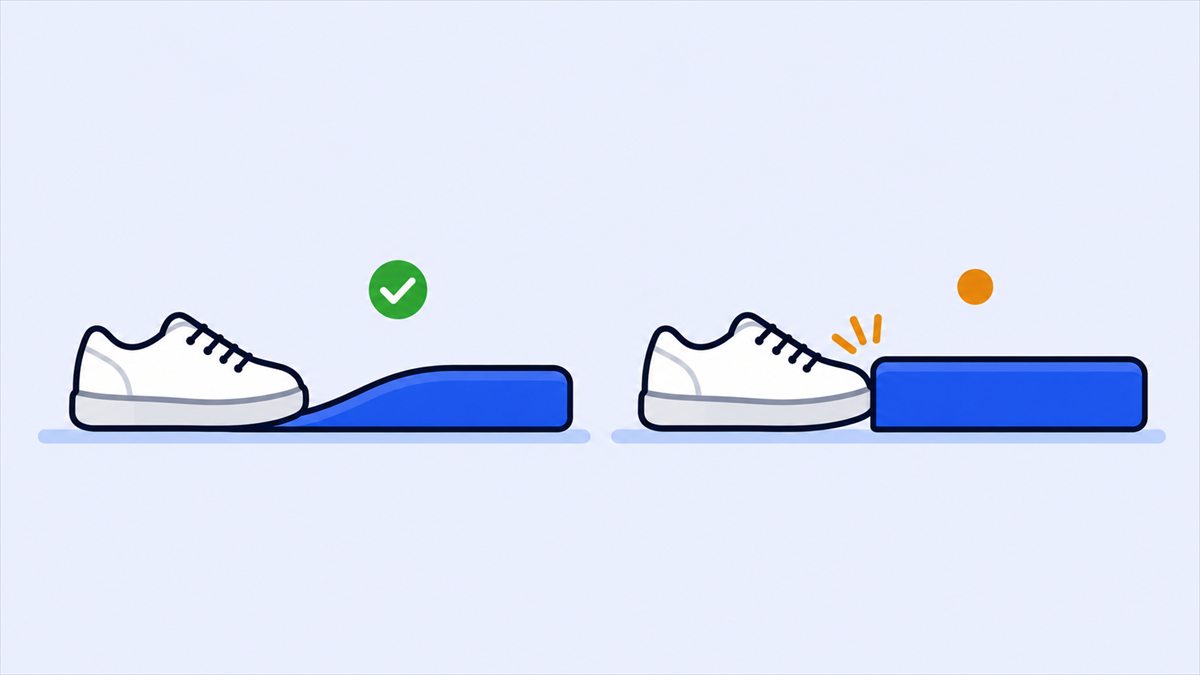
CCOHS says an anti-fatigue mat is meant to reduce tiredness from standing for long periods on a hard surface, and that it “may not solve the entire problem”: footwear, flooring and how the work is set up all matter. It says “softer and thicker” may not always be better, and that a mat should have some elasticity without being so soft that you cannot stand comfortably. It also warns that a mat can cause tripping if it slips or has sharp edges, and says sloped edges are less of a trip hazard. CCOHS gives no thickness figure.
A 2013 study in Human Factors had people stand for four hours on four commercial mats and on a hard surface. Compared with the hard surface, three of the four mats reduced discomfort at four hours, but the ratings did not differ significantly between mats, and the authors say no study had shown a particular mat to perform better than others. A 2022 study of 32 healthy college students compared two four-hour standing sessions, on a standing mat and on a hard floor: standing raised perceived exertion and hurt balance on both, less on the mat, and peak foot pressure was lower on the mat.
What this does not show: both studies used healthy adults in a lab, the 2022 study used one type of mat, and neither says what thickness is best. This guide therefore does not claim a mat will relieve pain or prevent a condition; it compares what makers state about size, thickness, weight and warranty.
What “thickness” means on each mat
The flat mats list one thickness: 0.75 inch (Vari and FlexiSpot per the makers, ComfiLife per its listing). The Topo lists two, 0.85 inch in its neutral area and 2.7 inches at its highest point, so it is thicker than the others only at the raised zones. A single “height” for the Topo is incomplete, which is why the maker’s page gives both figures.
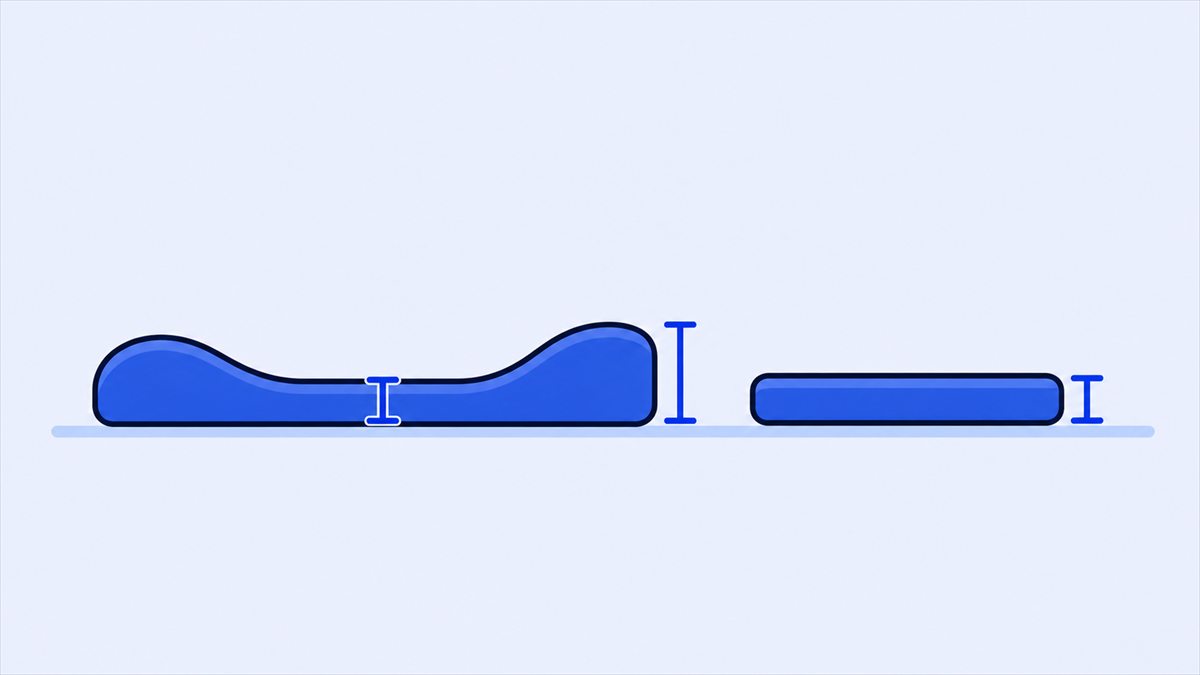
A bigger number is not a better mat. CCOHS says softer and thicker may not always be better, and the 2013 study found no significant difference in discomfort between the four mats it compared. Use thickness to judge how a mat fits your floor and desk: a raised edge is a step to cross, and a 2.7 inch mat will not slide under a desk that has a cabinet or a crossbar low down.
Check the fit before you buy
A mat that does not fit your floor space ends up pushed aside. Check these four things first:
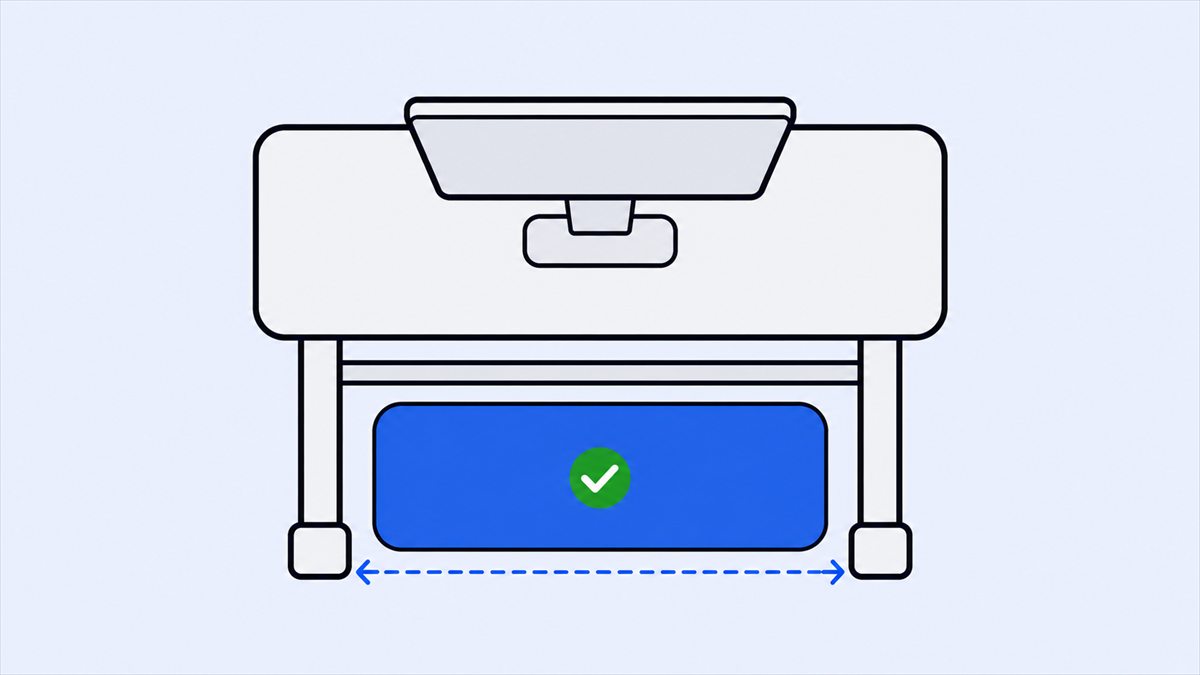
- Width between the legs. Measure from inside leg to inside leg. The footprints are the Topo 29 by 26.25 inches, the Vari 32 by 20, the ComfiLife 32 by 20 and, for reference, the FlexiSpot MT1 39 by 20.
- What is under the desk. TechGearLab says the Topo works best with desks that have nothing underneath. A drawer unit, a footrest or a crossbar may hit a tall mat.
- Your floor. TechGearLab found the Sky Mat Genius stayed put on carpet but would not stay put on a smooth floor, and that corners lifted on the Gorilla Grip Original and Kangaroo. Look for beveled (sloped) edges, which CCOHS says are less of a trip hazard.
- Whether you will move it. TechGearLab says no mat passed its chair-rolling test, so if you sit and stand through the day, choose a light mat you can slide away (the Vari is 3 pounds and the FlexiSpot MT1 4.1 pounds per their makers) or keep a chair mat separate.
If you sit on a rolling chair on hard floor, our guide to chair mats for hardwood floors and carpet covers the other mat under your desk.
The three anti-fatigue mats compared
Size, thickness, weight and warranty are as the maker or the seller’s Amazon listing states them; “not stated” means that source gives no figure. Price bands are as of November 22, 2026. The table further down shows every figure side by side, including the FlexiSpot MT1.
| Product | Shape | Size | Thickness | Warranty | Price band | Link |
|---|---|---|---|---|---|---|
| Ergodriven Topo Standing Desk Mat (Original) | Contoured (raised and flat zones), polyurethane foam | 29 x 26.25 in (maker) | 0.85 in neutral, 2.7 in at the highest point (maker) | 16 years (maker); 90-day free returns | $100–$200 | Check price on Amazon (opens in a new tab) |
| Vari Standing Mat Pro (32 x 20) | Flat, polyurethane foam with an integral skin | 32 x 20 in (maker) | 0.75 in (maker) | 10 years (maker) | $50–$100 | Check price on Amazon (opens in a new tab) |
| ComfiLife Anti-Fatigue Floor Mat, 3/4 Inch (20 x 32) | Flat memory foam | 20 x 32 in (listing) | 0.75 in (listing) | Not stated | Under $50 | Check price on Amazon (opens in a new tab) |
What each maker states, side by side
This table shows every figure that decides a purchase. “Not stated” means the maker’s page or listing we read gives no figure.
| Mat | Size | Thickness | Weight | Material | Warranty | Weight limit |
|---|---|---|---|---|---|---|
| Ergodriven Topo (Original) | 29 x 26.25 in | 0.85 in neutral; 2.7 in highest | 8 lb | 100% polyurethane foam | 16 years; 90-day free returns | Almost perfect up to 240 lb of user weight (maker) |
| Vari Standing Mat Pro | 32 x 20 in | 0.75 in | 3 lb | 100% PU foam with integral skin | 10 years | Not stated |
| Vari Standing Mat | 32 x 20 in | 0.75 in | 3 lb | PU top with PU foam core | 1 year | Not stated |
| FlexiSpot MT1 (sold on FlexiSpot’s own site, not linked here) | 39 x 20 in | 0.75 in | 4.1 lb | PU and PVC | Not stated | 300 lb |
| ComfiLife (20 x 32) | 20 x 32 in | 0.75 in | Not stated | Memory foam core (listing) | Not stated | Not stated |
Two figures to read carefully. The Topo’s 2.7 inches is the highest point and not the thickness of the whole mat. And the maker of the Topo says it holds its stated performance up to 240 pounds of user weight, which is a performance limit, not a safety rating; the FlexiSpot’s 300 pounds is a weight capacity.
Ergodriven Topo Standing Desk Mat (Original): contoured, most stated by the maker
Surface: Contoured, 100% polyurethane foam (maker)Thickness: 0.85 in neutral, 2.7 in at the highest point (maker)Size: 29 x 26.25 in (maker)Weight: 8 lb (maker)Price band: $100–$200
Ergodriven’s own page says the Original Topo measures 29 inches wide by 26.25 inches deep and 2.7 inches tall at its highest point, is 0.85 inch thick in the neutral area and weighs 8 pounds. It is 100% polyurethane foam, and the maker states it has no PFAS, PVC, plasticizers (phthalates) or added flame retardants. It sells a smaller Mini (25.2 by 19.2 inches, 4 pounds) and says the Original is for people 5 feet 5 inches and taller and the Mini for people 5 feet 4 inches and shorter.
The maker says the Topo performs almost perfectly up to a user weight of 240 pounds and does not reach its own specification above that. It offers 90-day free returns after delivery, then a 16-year warranty against manufacturing defects. The Topo is the only contoured mat here, and the maker’s page also lists the flat-area thickness, which is how it differs from the flat mats, whose listed thickness is a single figure.
Pros
- The maker states thickness in two places (0.85 inch neutral, 2.7 inches highest), the weight and the material
- A stated 90-day free return period, then a 16-year warranty against manufacturing defects
- The maker lists materials it says are left out: PFAS, PVC, phthalates and added flame retardants
- TechGearLab named it its best overall standing desk mat (July 2023)
Cons
- The highest point is 2.7 inches, so it is raised and not flat: the edge is something to step over, and TechGearLab says it works best with desks that have nothing underneath
- The maker says it falls short of its own specification above 240 pounds of user weight
- The most expensive of the three Amazon picks, in the $100–$200 band
- The shaped surface suits standing in place; it is harder to push a rolling chair across than a flat mat
Who should skip it
Skip it if you roll a chair across the floor where the mat sits, if you weigh more than 240 pounds, or if you want a flat surface with no raised zones.
What the sources say
Ergodriven’s page states a 16-year warranty. TechGearLab’s test (updated July 21, 2023) named the Topo its best overall, saying it gave great support and cushion, and measured it at 26.25 by 29 by 2.7 inches at maximum height. We found no study of this specific mat.
Vari Standing Mat Pro (32 x 20): flat, 10-year warranty
Surface: Flat, 100% PU foam with integral skin (maker)Thickness: 0.75 in (maker)Size: 32 x 20 in (maker)Weight: 3 lb (maker)Price band: $50–$100
Vari’s page for the Standing Mat Pro says it is 0.75 inch thick, 32 inches wide and 20 inches deep, weighs 3 pounds and is made of 100% polyurethane foam with an integral skin (a tougher outer layer) for heavy-duty use. It lists a 10-year warranty, a slip-resistant surface “certified by the National Floor Safety Institute”, beveled (sloped) edges, flat shipping and US manufacture.
Vari’s standard Standing Mat is the same size and weight with a polyurethane top over a foam core, and a 1-year warranty. Vari’s US standing mats page listed only these two mats on November 22, 2026.
Pros
- A stated 10-year warranty, the longest stated for any flat mat here (the Topo’s is 16 years)
- Beveled edges and a slip-resistant surface the maker says is certified by the National Floor Safety Institute
- Light at 3 pounds, per the maker, so it is easy to slide away
- Vari lists the size, thickness, weight and material on one page
Cons
- A modest footprint of 32 by 20 inches (the same as the ComfiLife), so check it against the space between your desk legs
- Flat and 0.75 inch thick: whether that suits you is not something a study can tell you, because the studies found no mat better than another
- Vari’s page does not state a weight limit or a return period
- No independent test of this mat
Who should skip it
Skip it if you want a contoured surface or a stated weight limit.
What the sources say
Vari’s page for the standard Standing Mat gives the same size and 0.75 inch thickness with a 1-year warranty, so the Pro is the one with the longer coverage. We found no independent test of either Vari mat, and neither page states a weight limit.
ComfiLife Anti-Fatigue Floor Mat, 3/4 Inch (20 x 32): lowest price, softest in one test
Surface: Flat memory foam, non-slip bottom (listing)Thickness: 0.75 in (listing)Size: 20 x 32 in (listing)Weight: Not statedPrice band: Under $50
The seller’s Amazon listing says this ComfiLife mat has a 3/4 inch core of high-density memory foam, measures 20 by 32 inches, has a non-slip bottom and a stain-resistant surface that wipes clean with a damp cloth, and is free of BPA, latex, lead and phthalates. The listing sells it for a standing desk and also for kitchens, laundry rooms and workbenches, and it does not state a weight, a warranty or a weight limit.
TechGearLab’s test of nine standing desk mats (updated July 21, 2023) called the ComfiLife the softest of all and best for short stints of standing.
Pros
- The lowest price band of the three Amazon picks (Under $50 as of November 22, 2026)
- TechGearLab found it the softest of the nine mats it tested and best for short stints of standing
- A non-slip bottom and a wipe-clean surface, per the listing
- Free of BPA, latex, lead and phthalates, per the listing
Cons
- TechGearLab says its softness suits short stints, so it may not be the pick for a full day on your feet
- The listing states no weight, warranty or weight limit, and we found no maker page with specifications
- It is sold for kitchens as well as desks, and the listing does not say whether the edges are beveled
- The TechGearLab test dates from 2023
Who should skip it
Skip it if you stand for most of the day and want firmer support, or if you want a stated warranty or a weight limit.
What the sources say
TechGearLab’s July 2023 test is the only independent source we found for this mat. It gave the size, called it the softest of the nine and best for short stints, and did not publish a weight or a warranty. The seller’s listing supplies the material and care details.
Verdict
No source shows that one anti-fatigue mat is better than another, so choose on fit. The Ergodriven Topo states the most (0.85 inch in the neutral area, 2.7 inches at the highest point, 8 pounds, 16-year warranty) and is the one to look at if you want a shaped surface and stand in one spot. The Vari Standing Mat Pro is the flat choice with a 10-year warranty on a 32 by 20 inch surface, and the ComfiLife is the lowest-priced and the softest in TechGearLab’s 2023 test but is best kept for shorter stints. We found no lab measurements for any of them, so every figure here is the maker’s or the seller’s own. The FlexiSpot MT1 is sold on FlexiSpot’s own site rather than Amazon, so it is shown in the table for reference and has no button.
Mats to check first, and things that are not mats
- Gorilla Grip Kangaroo and Original. TechGearLab says the corners of both lifted during its test, the Original early on. We list no pick from this brand because we did not find a maker page with specifications, and a lifting corner is a trip risk.
- Sky Mat Genius and Comfort Pattern. TechGearLab says the Genius would not stay put on a smooth floor and called the Comfort Pattern too slick to recommend.
- Wobble boards and under-desk treadmills. TechRadar’s roundup lists a balance board and a treadmill alongside mats. They are different products with different risks, and this guide does not cover them.
- The Vari ActiveMat. TechRadar’s September 2025 roundup lists it first, but it is no longer listed on Vari’s US standing mats page as of November 22, 2026, and its old link now goes to that page.
More guides
- Best chair mats for hardwood floors and carpet: what to put on the floor under your desk chair.
- Best monitor risers for a desk: work out the height and check the weight.
- Best leather desk mats: what “leather” means on a listing, and how to size the mat on your desk.
- All DeskConsensus guides: every guide in one place.
Frequently asked questions
Do I need an anti-fatigue mat for a standing desk?
Not necessarily. CCOHS says a mat may not solve the whole problem and that footwear, flooring and work setup matter too. A 2013 study found three of four mats reduced discomfort after four hours compared with a hard surface, so a mat may help, but the studies do not show it is required.
How thick should a standing desk mat be?
No source gives a right thickness. CCOHS says softer and thicker may not always be better, and a 2013 study found no significant difference in discomfort between four mats. The flat mats here are 0.75 inch thick; the Topo is 0.85 inch in the neutral area and 2.7 inches at its highest point.
Is a thicker mat better?
Not according to CCOHS, which says softer and thicker may not always be better and that a mat should not be so soft that you cannot stand comfortably.
Can I use a standing desk mat on carpet?
Yes, but check how it grips. TechGearLab found the Sky Mat Genius stayed put on carpet and would not stay put on a smooth floor, and that corners lifted on the Gorilla Grip Original and Kangaroo. Beveled edges are less of a trip hazard, per CCOHS.
Can I roll my chair over a standing mat?
TechGearLab says no mat passed its chair-rolling test. If you sit and stand during the day, pick a light mat you can slide away, or keep a separate chair mat.
Is the FlexiSpot MT1 41 pounds?
No. FlexiSpot’s own specifications list 4.1 pounds and a 300 pound weight capacity. TechRadar’s September 2025 roundup prints the weight as 41 pounds.
Is the Vari ActiveMat still sold?
It is no longer listed on Vari’s US standing mats page as of November 22, 2026; that page lists the Standing Mat and the Standing Mat Pro.
How we research
For this guide we used the makers’ own pages for the Ergodriven Topo, the Vari Standing Mat and Standing Mat Pro, and the FlexiSpot MT1; the seller’s Amazon listings for the Topo, the Vari Standing Mat Pro and the ComfiLife; CCOHS’s anti-fatigue mats fact sheet (last revised June 24, 2015, confirmed current January 25, 2022); a 2013 study in Human Factors by Wiggermann and Keyserling; a 2022 study in Applied Bionics and Biomechanics by Zhang and colleagues; and TechGearLab’s standing desk mat test (updated July 21, 2023). We do not test products ourselves, we found no lab test with measurements, and we do not use customer reviews, ratings or sale prices. Where a source gives no figure, the page says “not stated”. Price bands (under $50, $50–$100, $100–$200, over $200) were checked on November 22, 2026 and change with sales.
Written by